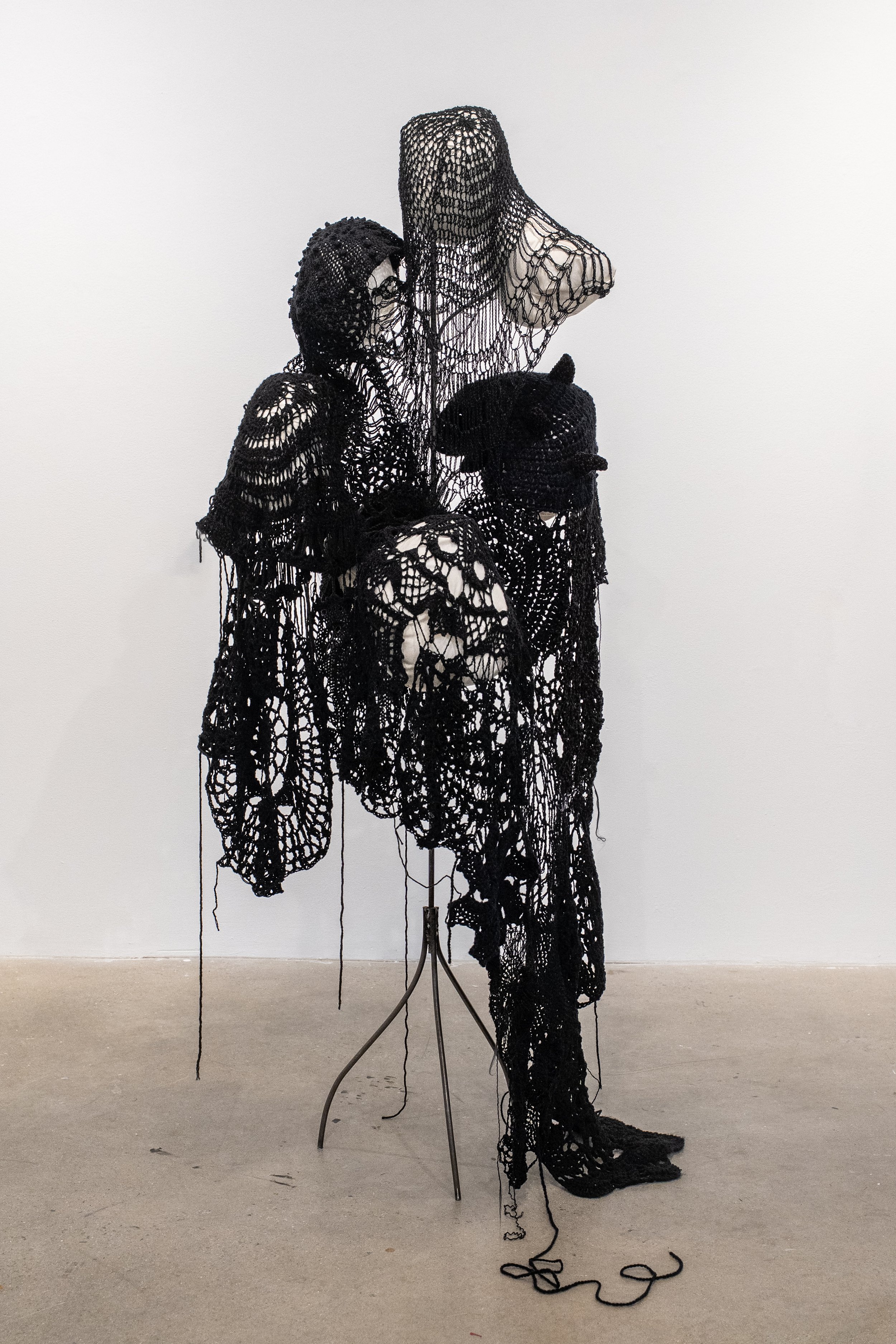
My practice draws from fashion within the Goth subculture. This aesthetic realm serves as a potent site of resistance, deliberately disrupting the normative, sanitized, and often restrictive standards of femininity prescribed by mainstream culture. With this focus I explore the questions “How can you control how you’re perceived?”, “How can fashion and clothing be a medium for sculptural work without directly reproducing the forms of garments?”, and “How can you engage with and express femininity without reinscribing stereotypical gender norms?”
Throughout my life I have felt that my physical appearance is something that people perceive and inevitably bring up. I can’t stop people accessing me based on my appearance, but I can dress differently. I find that when I wear more alternative clothes, people comment less on my body, but talk more about the things I wear, which I do have control over, which makes me feel that I have more autonomy and agency over who I am in society.
In this endeavor I am drawn to fashion and makeup as common and accessible ways to control my appearance, despite the fact that these are associated with traditional femininity and expectations surrounding women’s appearance. Perhaps this is somewhat inevitable as even caring about one’s appearance is often seen as feminine. Rather than avoiding femininity I aim to embrace it on my own terms. I feel that Goth fashion allows me to reclaim traditional markers of femininity like lace, velvet, and intricate detailing by twisting them through a lens of darkness.
My work celebrates and appreciates both the goth aesthetic and my personal experience. I use fiber art techniques like weaving, crochet and knitting in my work because fiber arts are central to the DIY aspect of subculture, and they are a part of traditional femininity which I wish to reclaim and uplift. Additionally these mediums provide a kind of softness through physical material and the processes of care.This softens the goth aesthetic that can be seen as more harsh or threatening like the dark colors and make my work more about the comfort I feel from the aesthetic.
I do not make actual garments as part of this body of work, but I do use the forms of clothing to suggest the body indirectly. I aim for the viewer to experience textiles as a figure in and of themselves, much in the same way that I want my aesthetic fashion choices to be a visual representation of me rather than my physical body.